Wednesday, March 30, 2011

IRRIGATION PUMP REMOVAL

 We are in the process of replacing our irrigation pumps that are used to pump water throughout the entire golf course.  The current pumps that are being replaced have over 16,000 hours on them and are performing at an insufficient level.  Meaning they are pumping a sufficient amount of water to the course but at a lower pressure.  This loss of pressure results in reduced coverage with each individual irrigation head and eventually weaker turf during the hot and dry summer months.  Here are some pictures of the pumps being removed from the pump house.


To take out the pumps we had to remove all the bolts and disconnect the wiring.  These are both 40 hp pumps that can pump out 800 gpm combined! 


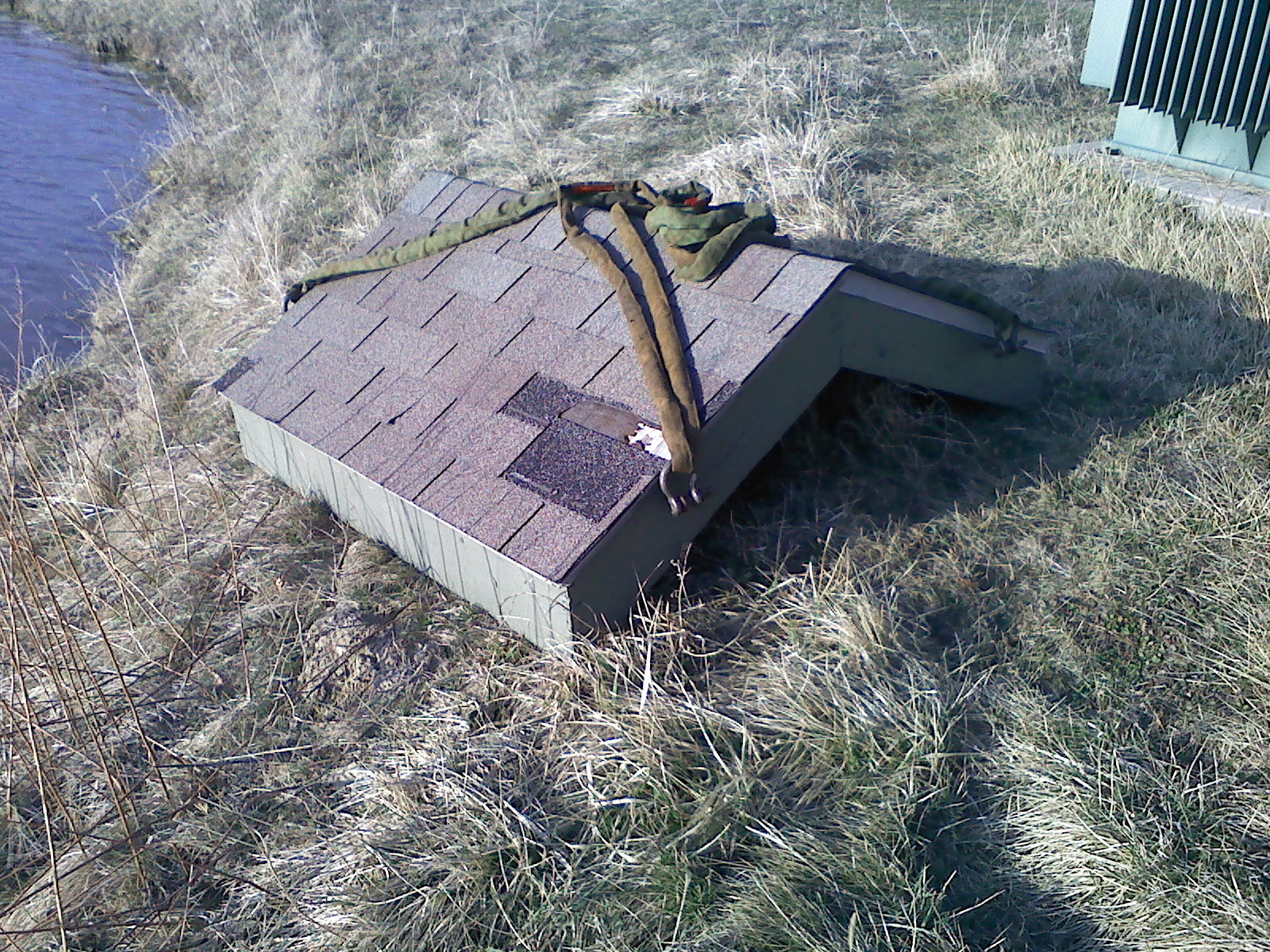
From here the pumps were removed by crane throughout the top of the building.  This is the portion of the roof that was removed to allow this to happen.


This is one of the motors being lifted out of the pump house.


The next few pics are of the pumps and shafts being removed from the wet well, notice the darker areas where the rust and scale are built up.  Under these chunks of rust the metal is really soft and brittle, that is what sulfer will do over time.


This is the screen at the bottom of the pumps.  The bottom was brittle enough that when lowered onto the flat-bed truck it nearly broke off!


With the shaft being worn out, sand and sediment were able to be moved up the column through the pumps.  This increases wear and can cause problems out in the field.  Clogged foot valves and worn out drives to name a few.  Here are a couple pics of the sediment that came through and pictures of the pumps on the bed of the truck.


From here, the next step is to clean out the wet-well and have the new pumps installed.  I will have another post with pictures to follow in the near future. 
Hope to see many of you on the course!

Friday, February 25, 2011

Is winter ever going to end?

Hopefully everyone is reading this blog from some place where it is 75 and sunny!  It is anything but that here at the golf course.  We are still working through our fleet of equipment and the end is in sight.  We have serviced all four of our turf gators, pictured below, and they are ready for the hauling of stone, sand and mulch when spring finally arrives!


Our tow behind blower has also been serviced and cleaned.  This piece of equipment does an outstanding job of moving leaves, small sticks and debris that has accumulated after the snow and ice from winter.  It is also run from a remote that can increase of decrease the rpm's and rotate the shoot on the back!


Trailer repair has kept us busy as well.  Our trailer that transports the sod cutter was in need of some new bearings and seals.  The old bearings were pretty rusted and the seals were shot.  Here is a picture of the axle before the new parts were assembled.


We also have two trailers to transport our walk mowers and they too have been worked on.  These trailers have been sanded down to remove some rust, then were primered and painted.


New tounges were made because the old ones were rusted out and too short in length.  Here are a couple pics comparing the old and new.


Push mowers have been serviced and cleaned.  Here are the two mowers, these don't take a whole lot of time to go through.


Last but not least, our aerifiers.  These play a vital role in the health of our turf during the golf season.  They can be used on greens, tees or fairways and the tines can be switched out from solid to hollow in an array of sizes.   They are transported throughout the course by hitches that Brad had made last winter.  That man can make and repair just about anything!


Here are some pictures of our solid needle tines that are used to vent the greens during the season.  This process allows for improved gas exchange in the root zone while at the same time improving surface drainage resulting in a firmer, healthier putting surface.


The hollow or "coring tines" are used to remove thatch and organic matter in the root zone, these are more aggressive than the solid tines and turf recovery usually takes a little longer.  These tines can vary is size from as small as 1/4" to as large as 7/8" depending on the location on a golf course and the severity of your thatch layer.  We typically do our coring in the fall, but early enough to have full recovery before shoot growth stops.  If the ground is not too saturated, spring can also be an opportune time to do aerification.  Here are some pics of new tines vs. old tines.  As you can see, they can wear down a great deal even after just one aerification job.


Monday, February 21, 2011

Mid-February thaw!

With the warmer temperatures this past week we were able to actually make a trip through the course without getting stuck and what we found was very typical for this time of year. 
It looked as though we had a decent amount of traffic this winter from cross country skiiers.  Here is a nice set of tracks right across one of our greens.....not recommended!  However, with spring growth and a bit of fertilizer, the tracks will disappear with no damage.


There were also a few foursomes that found their way to the course as well! Here are some close-up pictures of the effects of deer traffic on frozen greens during the winter. 


The deer traffic is a little more severe than the skiier traffic because of the depth of the impression on the green.  This is because the weight of the skiier was more evenly distributed across the length of the ski, where as the weight of the deer is only distributed over a couple of inches, or the length of the hooves.
Here are a couple more pics of deer traffic.


We also found a couple of drains that began to erode around the edges.  These will need to be dug up and concrete will be added to the drainage tile connections that have gaps in them.  As you can see in this picture, the ground has settled a couple of inches and will need to be raised after the repair is made. 


We have checked the status of the satellite box between holes #2/7 to see if moving the box to higher ground has paid off by keeping the box and its electrical contents out of standing water.  Here is a picture of the box, notice the ice and snow piled up where the box used to be.  It appears to have been a successful move, so far so good!


Microdochium Patch, a.k.a. snow mold, is visible on some locations throughout the course, none of which appear to be severe.  Microdochium Patch is a mold that can cause pink, yellow or tan patches measuring from 1 to 8 inches in diameter, these patches can coalesce into larger patches if severe enough.  This mold can be spread via water movement as well as foot or cart traffic.  Disease severity can be reduced by reducing thatch through aerification and verticutting, as well as reducing shade and leaf wetness.  In more severe cases a contact fungicide may be applied to reduce disease pressure, especially on highly maintained turf such as a golf green.  Here is a picture of the disease in one of our fairways.  The white around the edge of the patch is actually the reproductive spores, they can be either white or salmon in color. 


This all but too brief thaw is a reminder that spring is getting closer, so it's time to start thinking golf!  Dust off your clubs and we hope to see you out here on the course in the near future!


Friday, February 11, 2011

THINK SPRING!

I know it's hard to believe with the cold weather this week, but we should be mowing grass in about 35 days!  With spring not too far off we are still making good progress here in the maintenance department.


Currently we are working on our sand pro and we have replaced the raking tines on the back end.  Brad has had to take out the transmission because there was a small leak around the seals.  Here are some pics of the new and old tines.   We replace these things twice a year because the sand really wears down the tips!


The next pictures are of the back side of the sand pro and the transmission case.  Notice the two black circles in the case, that is where the oil was leaking.


We have also finished grinding the reels and bedknives on our walk mowers, sanded down the rust on our trailers and repainted them.


The trash cans, barricades and concrete yardage markers have all been cleaned and repainted.  They look good and will be put back on the course in March!


Last but not least are the weed whackers.  Spark plugs and air filters have been checked and cleaned if needed and they are ready to do some work!  Here is a before and after pic.


Monday, January 31, 2011

More Winter Work!

We are currently continuing with our winter work in between the snow storms that seem to be hitting us a couple times a week.  Since the last post we have completed some work that includes sanding and repainting of our driving range flags.  We always have two sets of red, white, green and yellow flags and flagsticks on hand in case one flag rips due to weather or a flagstick becomes cracked or broken.


Putting green flags and flagsticks are also ready to go this spring.


Ball washers are completed and will be set on the course once it is warm enough so that the water inside them does not freeze.   Looks like that may be a couple months away.  The ball washers are broken down to many parts that include the base, stem, spike brush and holder, plunger, basin and lid.   All the parts are cleaned, sanded and repainted before they go back to the course.


All 200 tee markers have been refurbished and have four to six coats of polyurethane applied to them to help  withstand the elements this season.


 Last but not least are the range dividers, these will also be sanded and repainted.

The Stone Ridge Maintenance Staff hopes that these blogs can help provide some insight to what takes place this time of year and we will continue to post projects and improvements as they take place.
Please be safe this week with this huge winter storm bearing down on us!

Thank you,

Stone Ridge Maintenance Staff

Wednesday, January 5, 2011

Well, winter is finally here and the most frequently asked question I hear is "what do you do this time of year at a golf course?"  The answer is "we do a lot of different tasks this time of year."  Here are just a few of the things we've been working on so far this winter.

Here is Brad, he is and has been our Equipment Manager since the course opened 12 years ago.  Brad's knowledge and experience are a huge assest for the Maintenance Department and his services are appreciated!  Brad is checking the reel for its quality of cut and to see if there is contact between the reel and bedknife.  This is a great time of year to service our equipment so that it's ready to go this spring.   We have a total of 28 reels in our fleet of equipment that will need to be serviced.


 This is one of our tee mower reels that is about to be sharpened on our Foley grinder.


 Tee markers!  Need I say anymore!  We will scrape, sand, add new logo stickers and finish these things with four coats of polyurethane.  This process is one of the more labor intensive tasks that we do.  With five sets of tee boxes on the course, this adds up to a lot of tee markers.   We will have 200 individual tee markers ready to go this spring, we always make a few extra for the ones that get lost or broken.


 Jon has been the Assistant Superintendent here since 2006 and he really enjoys peeling off the old stickers from the tee markers.  Jon started working here in the fall of 2000 and his services are greatly appreciated!


 Hazard stakes are in abundance throughout the course and these things take a beating!  Every winter we scrape these clean, sharpen the points if they need it and repaint them.


Another row of stakes that have been painted!


 We have a total of six clocks set throughout the course to remind our golfers to keep a nice pace of play.  These clocks are also sanded and painted.


Last but not least, our "150" posts.  They are sanded and repainted each year.  These posts are on every hole except for the par 3's.  They are located 150 yards from the centers of each green and are used to help golfers with yardages and also help with the pace of play. 

The Stone Ridge Maintenance Department hopes everyone had a great new year and we wish you the best in 2011!